Before the Cookbook: Recipes as Things People Remember and Pass Along
Before the cookbook, recipes lived in speech, gesture and memory. See what each form preserves, what writing changes, and how to choose what to pass on.
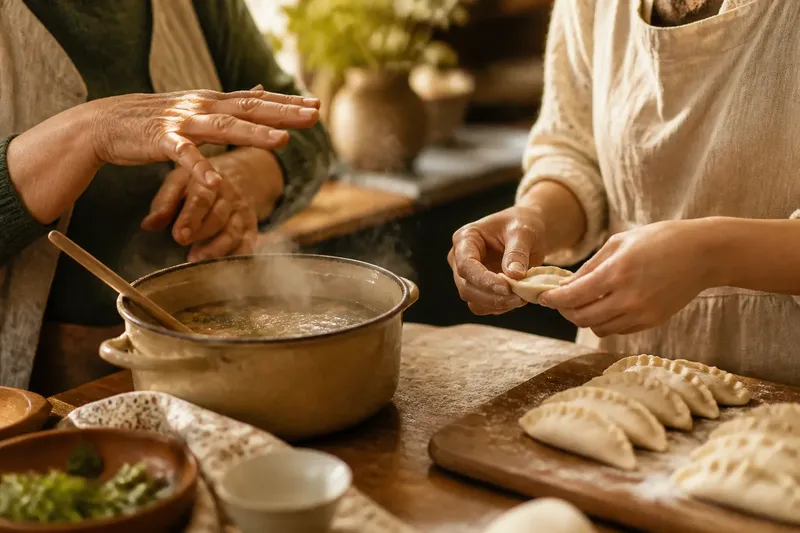
A hand hovers over a pot while someone says, “Add flour until it feels right.” Before the cookbook, recipes travelled in scenes like this: through spoken instructions, watched movements and memories built around a familiar dish. Each way of passing them on keeps different details alive.
Spoken, observed and written recipes are not simply older and newer versions of the same thing. They suit different kinds of knowledge. The choice matters if you want to share a family dish, keep a local food custom legible, or make a recipe usable by someone who cannot watch its usual cook.
What does spoken cooking preserve?
A spoken recipe can flex around the day. The cook might describe onions as “soft enough to sweeten”, then adjust the seasoning after tasting. A listener can interrupt, ask why the pan should be hot, or say that their flour looks different. Instructions become a conversation rather than a fixed sequence.
Speech also carries relationships. The same dish may come with a recollection of who made it for a gathering, which pot was used, or what was served alongside. Those details are part of the recipe’s meaning, even if they do not tell you how much salt to add.
This form suits cooks who share a kitchen, speak the same culinary shorthand and can respond to one another. Its weakness is dependence on presence and memory. An absent learner may inherit the dish’s name and story but miss the turn of phrase that signals when the onions are ready.
What can watching teach that words miss?
Observation makes small physical cues visible. A cook can show how dough should sag from a spoon, how a folded dumpling is pinched shut, or how a spice is rubbed between the fingers before it goes into the pot. The learner sees pressure, pace and texture, not just the final result.
Yet watching can leave gaps. A novice may see a smooth dough without knowing whether it took a little water or a long knead to reach that state. A familiar cook may perform a gesture so naturally that it never occurs to them to explain it. Observation works best when the learner can pause the action and ask what a change in colour or feel means.
Say an older relative is showing a cousin how to make a savoury pastry. They roll one piece, let the cousin try, then point out that the edge needs a firmer pinch to hold the filling. The cousin can imitate the motion and see the difference immediately. A short note about dough texture would help later, when that demonstration is no longer in view.
What changes when a recipe is written down?
Writing gives a recipe a form that can travel beyond its original kitchen. A note in a notebook can be lent, copied or kept beside the stove. It can preserve an ingredient order, a remembered substitution and the name of the person who taught it. For a cook who works alone, written directions provide a route back into a dish without waiting for a demonstration.
But recording also edits. A writer has to decide what counts as an instruction and what can be left unsaid. “Cook until fragrant” preserves a sensory cue, but a newcomer may not know what that smell should be. A precise quantity may make the page easier to follow while hiding how the original cook adjusted for a wetter ingredient or a different pan.
Think of a written recipe as a sketch of a room. It can mark the doors and furniture, but it cannot convey the warmth of the kitchen or the sound of people talking there. A page is not a lesser version of the meal; it is a different vessel, with its own omissions and strengths.
Which form suits the person learning?
The best form depends on what the learner needs and what the dish asks of them. A recipe with familiar ingredients and clear stages may travel well as a written note. One that relies on delicate shaping or a changing texture may need demonstration. A dish tied to a family occasion may benefit from spoken memories as much as cooking directions.
- Choose speech when the learner can ask questions and the cook can adapt instructions as they go.
- Choose observation when hand movements, texture or timing are hard to describe on a page.
- Choose writing when the recipe needs to reach someone who cannot be present or needs a reminder later.
- Combine forms when the dish has both precise stages and cues that depend on sight, smell or touch.
These are not competing claims about authenticity. A spoken version may shift as one cook teaches another; a written version may hold one arrangement still. Which matters more depends on whether your priority is adaptation, faithful repetition, or keeping the story attached to the method.
How can a written recipe leave room for memory?
A useful record need not pretend to capture every movement. Write down the parts likely to vanish first: the order of ingredients, a visual cue, a common adjustment, and who taught the dish. Leave space for the learner to add their own notes. That way the page can support another round of cooking without claiming to be the only valid version.
Where a quantity is uncertain, say so plainly rather than turning an inherited approximation into false exactness. “Add enough water for a soft dough” is more honest when followed by a description of the feel than by a made-up measure. A brief note can also name what to watch for: a glossy surface, a loose mixture, or a fragrance that changes as it cooks.
What do readers ask about recipes passed down?
Can a recipe exist without written quantities?
Yes. A recipe can be carried through repeated practice, sensory cues and spoken guidance. Quantities help some learners, but they are only one part of cooking knowledge.
Why do family versions of the same dish differ?
Each cook may adapt to available ingredients, household habits or personal taste. The differences can be part of the dish’s living history rather than evidence that one version is wrong.
What should I record when I inherit a dish?
Note the sequence, the signs of readiness, any adjustments the cook mentions and the dish’s name or occasion. If possible, ask what the cook is looking, smelling or feeling for at each uncertain point.
Does writing a recipe preserve the original exactly?
No page can hold every gesture, memory or kitchen condition. Writing preserves selected details, while a demonstration or conversation can carry others; together they make a fuller account.
Before the cookbook, a recipe could be remembered in a voice, a hand movement or the feel of dough under a palm. To pass one on now, choose the form that preserves its most easily lost knowledge—and leave room for the next cook to add theirs.