A First Visit to a Food Market: What to Notice Beyond the Stalls
A first visit to a food market can feel richer when you notice its routes, rhythms and exchanges, even if you leave without buying a thing.
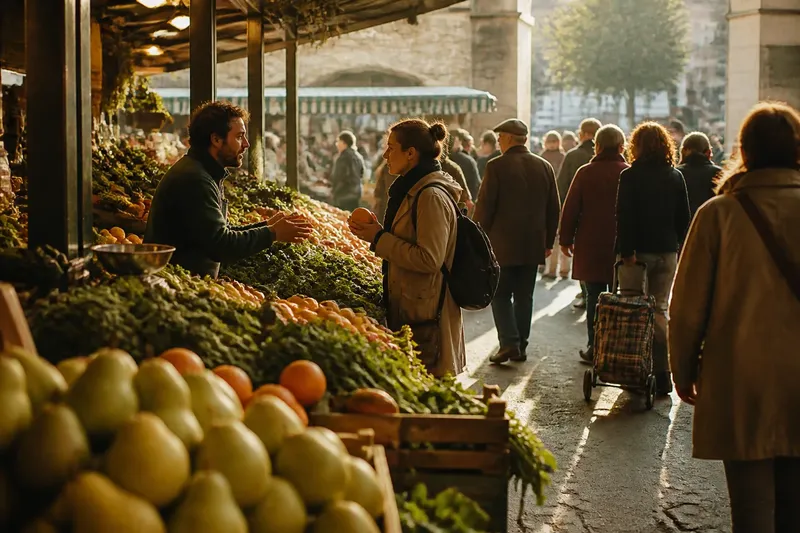
A first visit to a food market might begin with a basket of pears catching the morning light, a vendor sliding a crate aside, and a queue bending into the walkway. The first visit to a food market can be more than a hunt for ingredients: give yourself a little time to notice how displays, movement and exchange shape the place. You need not buy anything, know the local customs in advance or make a complete circuit.
Think of the market as a small room whose furniture keeps moving. Stalls, voices, smells and passing bodies guide attention, while shoppers continually rearrange the available paths. A simple observation plan helps you take in that changing scene without turning a leisurely visit into a checklist of things to acquire.
Before you arrive, what will you leave room for?
Choose a modest span of time that fits your day, then decide what you are curious about. Perhaps you want to see how the market wakes up, how shoppers choose between similar vegetables, or where people pause to talk. One question is enough. It gives your attention somewhere to rest without deciding in advance what the market ought to show you.
Travel light if that makes looking easier. A phone can be useful for a note, but it can also keep your eyes on a screen. You might bring a small notebook and pencil, or simply remember one detail to think about afterwards. A camera is not necessary; if you do want to make an image, consider whether people are clearly identifiable and whether asking first would be more courteous.
Arrive with no obligation to complete a circuit. Markets can be crowded, noisy or arranged in a way that is hard to read at first. Let the first few minutes be about finding your bearings, not proving that you have seen everything.
At the entrance, how does the market announce itself?
Pause where you can do so without blocking anyone. Notice what reaches you first: a row of bright citrus, the damp scent near fish, a burst of conversation, or the sound of a trolley crossing uneven paving. The entrance may reveal a strong visual line, but the market’s character can also arrive through its smells and noises before its layout makes sense.
Look for the broad shape rather than reading every sign. Are the stalls arranged in lanes, clusters or a loose square? Do customers move in one clear direction, or do they cross and double back? Notice the places where movement slows: a narrow corner, a stall with a long queue, or an open patch where people gather to decide where to go.
Stand aside and watch a flow pass rather than trying to inspect the busiest point from its centre. A market is a working place, and a good vantage point is one that lets other people carry on. If the entrance feels compressed, step towards an edge and let your eyes adjust to the scene.
On your first circuit, what draws people in?
Walk at an easy pace, keeping the route flexible. Notice how a display meets the passer-by. A pyramid of oranges may face the lane; leafy bunches might spill towards it; jars and packets may sit at eye level. These arrangements do more than show what is for sale. They shape what people can see, reach and compare as they move.
Watch for small invitations. A sign handwritten in broad strokes, a sample offered on a tray, or a vendor turning a crate to show a different side can prompt a pause. So can a vivid colour among quieter produce or the scent of herbs released when someone lifts a bunch. Ask yourself what you noticed before you understood why it caught your attention.
Then compare one stall with its neighbours. Similar goods may be presented in different ways: stacked in boxes, lined up in bundles or arranged loose across a table. The differences can suggest different ways of choosing—by amount, by appearance, by familiarity or through a brief conversation. Avoid assuming that a display tells you everything about the people who made or sold the food. It gives you a visible detail, not a full story.
As the market gets busier, where does movement change?
Make another pass, or simply stay at the edge of a lane long enough to see how it changes. A quiet route can become a bottleneck when a delivery is moved or a queue grows. Some shoppers move directly towards a familiar stall; others drift, stop, and change direction when something catches their eye.
Notice the difference between looking and waiting. Someone leaning towards a display may be comparing produce; someone standing back may be making room for another customer; a small group may be negotiating what to buy together. These gestures are easy to misread from a distance, so keep the observation modest: describe what you can see rather than guessing at a person’s purpose.
Pay attention to how space is shared. A pram, handcart or shopping bag can alter a narrow lane, as can a vendor carrying a box behind the counter. People may turn sideways, step aside or briefly pause to let one another through. Those little adjustments help explain the market’s rhythm as much as the stalls do.
During an exchange, what happens between seller and shopper?
Choose an interaction you can observe without hovering over it. A customer might point to a bunch of greens, ask a question, or hold two pieces of fruit side by side. The vendor may answer, weigh an item, wrap it, or suggest another option. Look at the sequence: who begins, what is shown or handled, and how the exchange reaches a natural stopping point?
Listen for the sounds that carry across the lane: greetings, calls about produce, the rustle of paper, a scale’s click, or a short exchange about how to prepare something. You do not need to understand every word. Tone, pauses and gestures may show when a conversation is practical, familiar or playful, but they cannot tell you the whole relationship between two people.
If you decide to speak with a vendor, make your question brief and relevant to the stall. Asking what an unfamiliar vegetable is called, or how it is commonly served, leaves room for a useful answer. If the person is serving a queue, wait or move on. A market visit does not require a conversation to count as attention.
What should you notice without buying?
Browsing can feel like a request to choose, especially when a vendor is nearby. You can keep your hands to yourself, avoid blocking the counter, and move on with a polite thanks if someone addresses you. If you want to sample or handle something, ask first rather than assuming that an invitation extends to every item.
Say you arrive with no shopping list and notice a stall selling unfamiliar mushrooms. You could pause at the edge, read the labels, watch how customers point and ask questions, then leave the display clear for the next person. The observable result is a closer sense of how people approach the stall, without a purchase or an invented claim about what the mushrooms taste like.
Leaving empty-handed is not a failure to participate. Your attention can follow a colour, a route through the lanes, or the way a vendor rearranges a display after customers have passed. If a particular item genuinely interests you, you can still buy it; the point is that purchase need not be the price of paying attention.
Near the end of your visit, what is worth carrying away?
Before leaving, choose one spot that felt different on the way back. Perhaps the queue has shifted, the light has moved across a table, or a once-busy lane has opened up. That small comparison can make the market feel less like a static collection of stalls and more like a place altered by people’s choices.
Take a quiet moment afterwards to note three things: one detail you saw, one sound or smell you remember, and one question you still have. Keep the note descriptive. “Green beans in shallow trays, customers picking up the corners to look underneath” is more useful than “everyone likes the fresh produce”, which claims more than a brief visit can establish.
On a return visit, you can follow that question rather than repeating the same route. You might notice how one stall’s display changes through the day, or whether shoppers pause at the same junction. A first visit to a food market is most rewarding when it leaves you curious, not when it leaves you with a perfect account of everything happening there.
What do first-time market visitors often ask?
Do I need to buy something to browse?
No. You can look without purchasing, provided you leave space for customers and do not handle goods without permission. A brief, courteous thanks is enough if a vendor speaks with you.
Is it better to visit early or later?
Different times can reveal different rhythms: an early visit may show setup and fresh displays, while a later one may show busier lanes or changing stock. Choose a time that suits your day and observe what is happening then, rather than expecting one visit to represent the whole market.
Can I take photographs?
Market signs and displays may be easy to photograph, but a close image can include people who did not expect to be part of it. Ask before photographing identifiable individuals, and put the camera away if it makes a vendor or shopper uncomfortable.
What if the market feels too crowded?
Step to an open edge, take a pause, or leave and return another time. You can still notice the market from a quieter position; there is no need to force your way through a bottleneck.
Let the last detail be a practical one: on the way out, notice where people naturally slow down and how they find their next turn. That small observation can help you feel more at ease on a future visit, whether you return to shop, to ask about a local ingredient, or simply to watch the market find its rhythm again.